
Updating or renewing information systems requires various skills and vision, as well as an understanding of the direction in which the company’s business is heading. Although it might sometimes be easiest to start with a clean slate, it is nevertheless important to analyze not only future needs but also the current situation: what is good and what functions well in it. On the other hand, one must consider which aspects require change either immediately or in the near future.
Let us take an example of a similar situation from a somewhat different world. In my free time, I am interested in classic American cars, and upholstery work is a particular area of interest for me. My current project is a 1958 Pontiac Bonneville, whose upholstery has seen better days. There is certainly no shortage of challenges when it is difficult to even create a pattern from a mere hole that once was a seat.
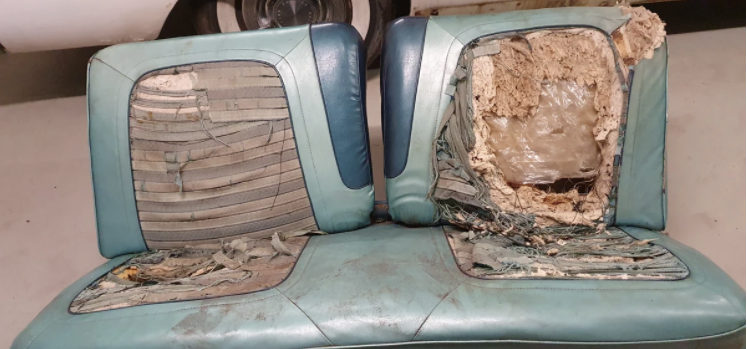
Before the sewing machine starts singing, a considerable amount of research and planning work must be done as the foundation for the project. The seats and upholstery must be photographed and documented comprehensively enough. After this, the dismantling work begins, along with marking and unpicking the parts of the old upholstery.
These car seat cushions were, in places, reduced to little more than a pile of crumbs. The new cushions need to follow the originals as closely as possible, while still improving on them. That means the new upholstery will require some adaptation and adjustment to fit the new cushions properly. And if something was done oddly in the old upholstery, there’s no point repeating it unless the benefit is clearly obvious.
With careful documentation, the next project is always a little easier
The entire process therefore requires good planning, experimentation, and learning from mistakes. When creating something new, one must remember to continuously photograph the different work stages and document sufficiently so that the next project will then be somewhat easier.
I see many similarities between restoring the upholstery of an old car and developing and renewing information systems. Old systems must be documented to enable further development and renewal. When developing something new, one must always be able to adapt and consider what could be done differently and perhaps better than before. In exactly the same way, in system development one sometimes has to “unpick and sew” again. In both cases, good planning and documentation help both the current implementation and future projects.
Below are five aspects that I consider important in documentation.
We document:
- The right things, for the right purpose
We focus on what is essential and what is actually the subject of documentation. We only document according to need and for intended use. - At an appropriate level
There is no need to complete everything to perfection all at once. We also document iteratively. - Clearly
Documentation must be done so clearly that others besides the author can understand it. If there is room for interpretation in the documentation, the possibility of errors also increases. - In a timely manner
Documentation must be available when it is needed. - Maintainably
Documentation must also be maintainable and maintained so that it is useful later for both the business and future development projects.
Documentation is an important part of development. And when one looks slightly outside the box, one notices that the same principles of documentation apply to surprisingly many areas in addition to system development, such as car seat upholstery, for example.

Tarja Kunnasvuo
Tarja is an ISTQB-certified testing professional who keeps the threads of testing in hand with over ten years of experience. Tarja has diverse expertise related to testing, test coordination, and the development of testing practices.


