
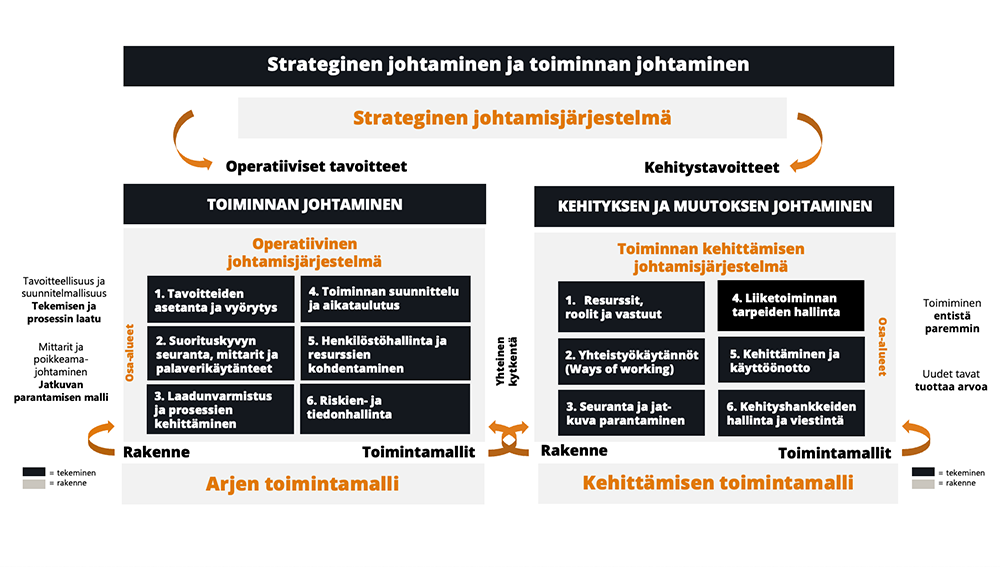
This is the final blog in a three-part series. While the second article in the series introduced us to the operational management system and the daily operating model within a company, this article focuses on presenting the management system for operational development. I will explore the fundamental elements and structures of development and change management.
Development and change management is about execution, and the structure within it is called the management system for operational development. As I noted in the first part of this series, it is common for development and change to be managed through a single operational management system. The perception of development and change is that they can run agilely alongside daily operations. Management and change agents are too busy to pause and consider whether there is any alternative structure at all.
We at Reflector are constantly at the center of change and have paused to consider a solution to this. We have developed an alternative model for companies to manage development and change without compromising daily operations.
Areas of Operational Development and Their Roles
Below is a description of the management system for operational development and its various areas, as we see them at Reflector. In concrete terms, this manifests in companies as incremental improvements, projects, and larger initiatives. Input for change can come from the operational management system, daily operations, or externally, for example directly from strategy.
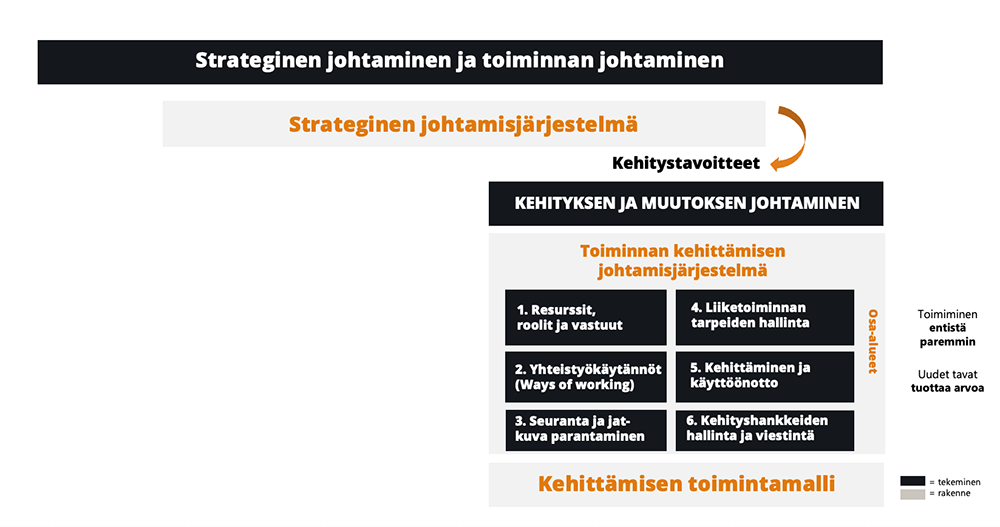
I will illustrate the roles of the different areas through brief examples.
1. Resources, roles, and responsibilities
The most important area, which enables all other areas. Development and change are difficult to implement and manage if sufficient resources have not been allocated. Quite quickly, projects experience delays and development begins to fall behind schedule. It is equally important to carefully define roles and assign responsibilities to change agents.
This eliminates many question marks along the change journey, because everyone knows what is expected from whom, when, and why. Invest and allocate time to planning and implementing this entirety before starting development work. It will certainly pay back many times.
2. Ways of working
This refers to both practices within operational development and practices to be planned with the operational management system. Let us take a practical example of both:
- Operational development is planned with systematic practices (e.g., meetings) where progress status, potential risks, threats, and dependencies are reviewed, and prerequisites for development, such as resources, are ensured.
- To maintain a permanent link between development and daily work, practices must also be planned where both development and operations can present their respective status. In addition to the status, these practices should establish what the objectives, resources, and any testing or piloting requirements are for the upcoming reporting period or phase, to which operations must prepare. The goal is to create a shared plan and aligned objectives.
- To avoid giving the impression that we are only planning new meetings for already full calendars, I should clarify that we mean that practices form Ways of Working. Working together does not necessarily require meetings; it can be accomplished using digital tools such as Teams, Jira, Confluence, email, etc.
3. Monitoring and continuous improvement
- An important area where strategy-derived development objectives come into the picture. Setting the right monitoring metrics for objectives and systematic tracking as part of the collaborative practices above create a solid foundation for continuous improvement.
- Three essential metrics immediately come to mind: throughput time, investment size (EUR), and resource availability (fulfillment percentage). These metrics are interdependent.
- Prerequisites for success in this area are disciplined management and consistency. Managers must be able to demand, monitor, and communicate development progress both downward and upward. A systematic coaching and caring approach balances different aspects of management and leadership to help employees endure even the most demanding phases.
4. Business needs management
- The purpose of this area is to bind business and IT together. It is beneficial to have mutually agreed enterprise architecture principles and guidelines in place. These provide an unwavering foundation for ensuring that development occurs within agreed-upon rules of engagement.
- This area ensures that only the right things are done and selected for execution—things that move toward a common target state and belong to the managed development portfolio. Before development is initiated, it is ensured that business development objectives are understood holistically and that it is natural to create shared development plans and Roadmaps based on these objectives.
5. Development and deployment
- The needs of business management pushes development work forward through the funnel. This area involves many different development phases, such as detailed planning, implementation, quality assurance, and release management. Execute the development work that has been selected for execution, do it right, efficiently and on schedule.
- One of the key tasks of this area is to ensure that we do not rush too quickly to develop and solve individual or isolated needs from operations in a “tool-first” mode, but proceed systematically with a holistic approach.
6. Development project management and communication
- Project selection, prioritization, and resourcing should be based on the organization’s long-term objectives and vision. Project management methodologies (Prince2, SAFe, Agile/Scrum, DevOps) are tools by which the organization ensures that projects are planned, executed, monitored, and closed in a consistent and efficient manner.
- This area links to management system area #1 and operational management system areas #4 and #5.
- A communication plan is a central part of the management system for operational development. This includes internal communication between teams as well as external communication to customers, suppliers, and other stakeholders. Communication must include regular reporting on projects and change communication.
- Integrating development project management and communication into the management system requires management commitment, clear processes, and continuous evaluation. When these elements are combined, the organization can improve its performance, achieve its strategic objectives, and respond more quickly to a changing operating environment.
The Development scope
When the areas described above are in use in operational and change management, one can speak of an established development operating model within the company. Operations are characterized by new ways of creating value, and there is a strong hunger within the company to operate better than before, all the time.
The posted image organizes the three-part series into a coherent whole.
This article concludes the three-part series, which has been previously published:


