
When it comes to making development more efficient, the greatest benefits of AI don’t come from an organization having access to the best possible models. The benefits come from understanding, within the organization, how information flows through the value streams of development and how it can be used more effectively. AI acts as an accelerator, but the real raw material of development is still information and its context.
‘AI-enabling’ the development pipeline as a whole happens through understanding development capabilities and value streams
It’s easy to approach the use of AI in development through individual use cases. For example, you can build various assistants for requirements specification or project management. At their best, these do bring benefits to development.
The work of an individual expert or team becomes more efficient, but the overall development lead time, quality, or predictability don’t necessarily improve significantly. The risk is that the results remain localized.
The reason is simple: AI doesn’t operate in a vacuum. Its real value comes from information, context, and the ability to function as part of the entire development life cycle.
Instead of asking where in the development process it’s worth using AI, we should start with the question:

Step 1: Identify the development capabilities
The first step is to describe the development pipeline as capabilities (Business Capabilities).
A capability describes something that an organization must be able to do, regardless of organizational structure, processes, or the tools used.
Typical development capabilities may include, for example, demand management, prioritization, requirements specification, solution design, project management, and so on. Based on my own experience, most organizations can identify around 20–30 of these.
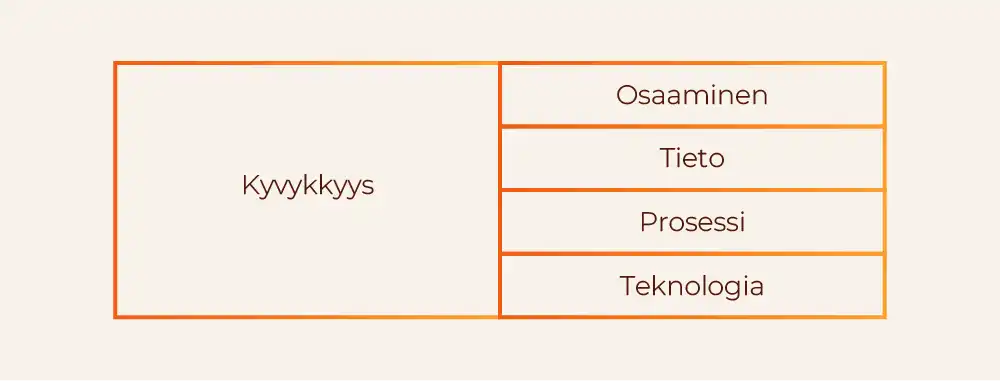
For each capability, four perspectives are examined:
Competence – What do we need to know in order for the capability to be realized?
Information – What information is needed to do the work, and what is produced?
Processes – What is the workflow, how does the work happen?
Technology – What tools is the work done with?
Simply identifying these things already opens your eyes to the diversity of the development pipeline and fuels discussion about using AI in development. Of course, when examining a single capability, we’re still working within a limited context, so the scope needs to be widened.
Step 2: Examine the development value streams across capabilities
Requirements are written down in one place, plans in another, decisions in a third, and the lessons learned from the project ultimately remain only in people’s memories. This is where it helps to look at capabilities as a network and at the development value streams running through them.
It’s usually not a single work stage that slows down development lead time, but rather the breakdown of information flow between capabilities.
There are several streams, and they usually have different needs. For example, the value streams for large projects, small-scale development, and portfolio management differ from one another, even though they rely on similar capabilities.
Although value streams differ from one another, one thing unites them all: information travels along with value. For this reason, modeling value streams isn’t primarily about describing processes, but about understanding the flow of information and information needs.
From a development perspective, what’s interesting is that most of the work doesn’t actually create new information, but rather refines existing information for the next intended use. Business needs are turned into requirements, requirements into plans, plans into executable tasks, and finally into testable solutions.
At each stage, information is reinterpreted, supplemented with new context, and passed on to the next actor. At the same time, this inevitably creates a risk of information being lost, misinterpreted, or stripped of its context. This is precisely why examining value streams from an information perspective is so important.
Step 3: Identify the AI capabilities needed
Once we understand the development capabilities and the value streams running through them, we can move on to actual AI planning. At this stage, it’s worth replacing the question “Where could we use AI?” with the question “What AI capabilities do we need to make the overall development process more efficient?”
It’s easy to fall into the trap of starting from individual use cases. A better starting point is to examine the development value stream stage by stage and follow the information flowing through it. The goal is to identify where information is created, changed, transferred, or loses its context. These are precisely the points where AI often has the greatest potential.
Here, I’ll present a three-stage method:

1. Enable:
Can the information be brought into the same context?
The first perspective relates to the availability of information. Before AI can help, it needs access to the right information in the right context.
In many organizations, the information needed at different stages of the value stream is scattered across numerous systems, documents, tools, and the tacit knowledge of experts. For example, the success of requirements specification may depend on combining business objectives, earlier specifications, architectural principles, project decisions, and system descriptions. If these are located in different places, the first task for AI may not be automation but rather creating a shared information context.
At this stage, it’s worth asking what information is needed at each stage of the value stream, where it can be found, and whether its connection to other stages is understood. Often, the first AI investments relate to combining information, semantic search, or building a shared information model. The goal at this point isn’t yet to automate things, but to make it possible for information to be findable and understandable regardless of which system it originally resides in.
2. Enrich:
Can AI enrich the information context?
Once information is available within the same context, we can consider the next level: can AI help us understand information better than we do today?
During development, the same piece of information passes through multiple people and capabilities. At the same time, its original meaning can easily start to become blurred. A developer sees the user story but not necessarily the business need behind it. A tester knows the implementation details but not necessarily the decisions on which the solution was originally based.
This is precisely where AI can generate significant value. Rather than simply performing the task on a person’s behalf, it can enrich the context needed for decision-making. Information about similar past projects, identified dependencies, technical constraints, implementation costs, or impacts on other business capabilities can be automatically brought into the context of a development need, improving the quality of the task being carried out.
In practice, the AI solution then functions as the organization’s collective memory. It helps combine scattered information into a new, unified view that supports decision-making at every stage of the value stream. AI doesn’t make the decision on a person’s behalf, but it can significantly improve the quality of decisions by providing more context than any single expert could ever gather.
3. Automate:
Can AI perform tasks or support expertise?
Only after this does it make sense to ask whether the work itself can be automated. Once information is available and its context is understood, individual capabilities can be examined from the perspective of expertise.
At this stage, attention shifts to what experts actually do at different points in the value stream. What is time spent on? Which tasks are based on processing information? Which are repetitive and rule-based? Where is human judgment, accountability, or decision-making required?
For example, in requirements specification, AI can draft the first version of a requirements document using business context gathered in earlier stages. In project management, it can compile status reports, track dependencies, and identify deviations based on project data. In testing, it can generate test cases, analyze error reports, or suggest corrective actions.
At the same time, it’s important to identify the decision points within the value stream. Although AI is capable of analyzing options and producing recommendations, business prioritization, approvals, risk-taking, and strategic choices remain the responsibility of people. At its best, AI acts as an expert’s working partner, speeding up preparation and improving the quality of decisions.
In practice, this results in a simple but effective operating model. First, the use of information is enabled by bringing it into a shared context. Next, the information is enriched with new perspectives and connections. Only after that is it assessed what can be automated or delegated to AI.
An organization cannot automate what it does not understand.
Once information is able to flow through the development value streams in the right context, the true potential of AI also begins to emerge.


